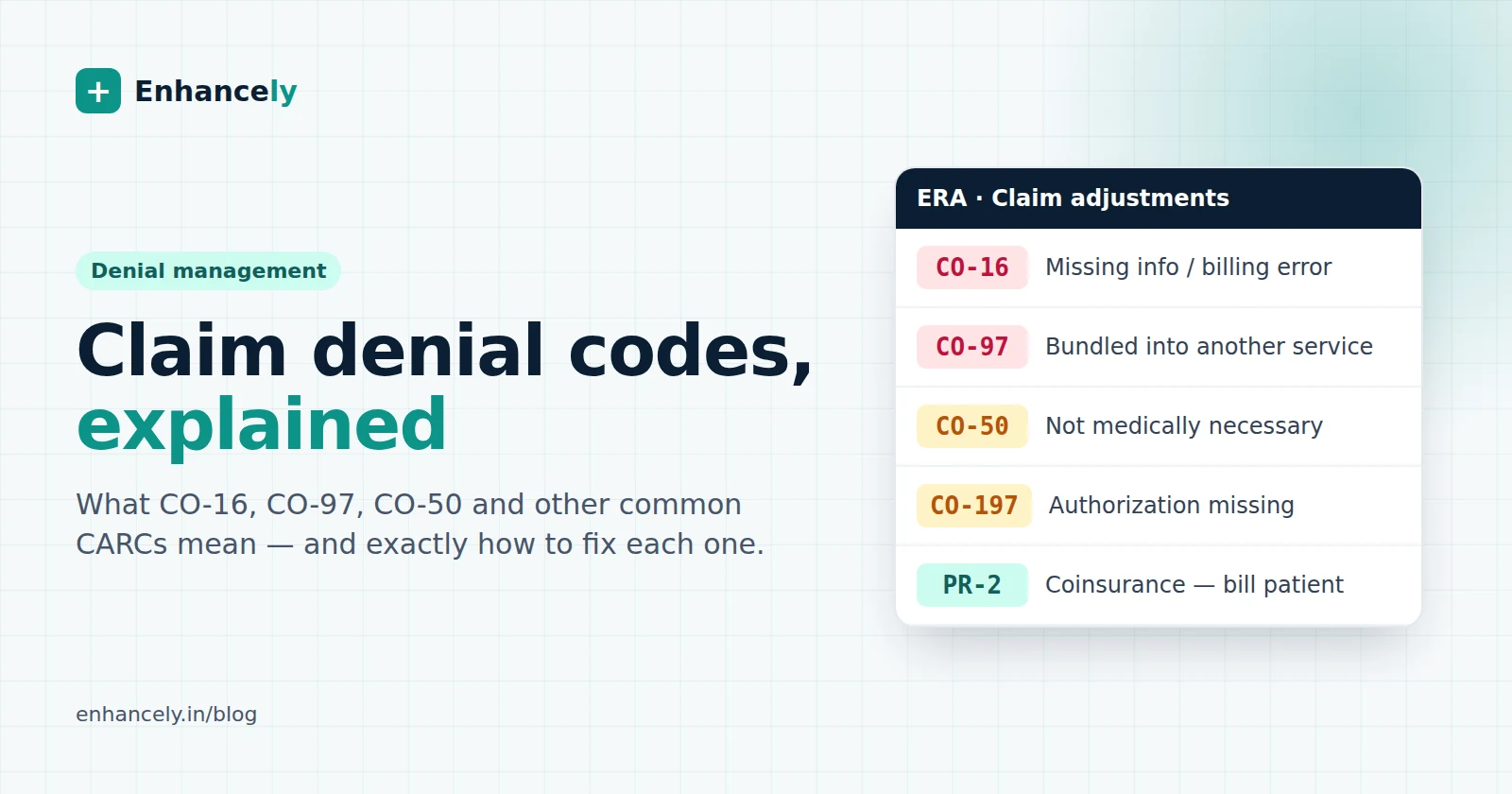
Every denied or adjusted claim comes back with a short code: CO-16, CO-97, PR-2, and so on. Knowing what each one means, and what to do next, is the difference between fixing a claim in five minutes and letting it age into write-off territory. This guide explains how denial codes work and walks through the ones billing teams see most, with a practical fix for each.
How to read a denial code
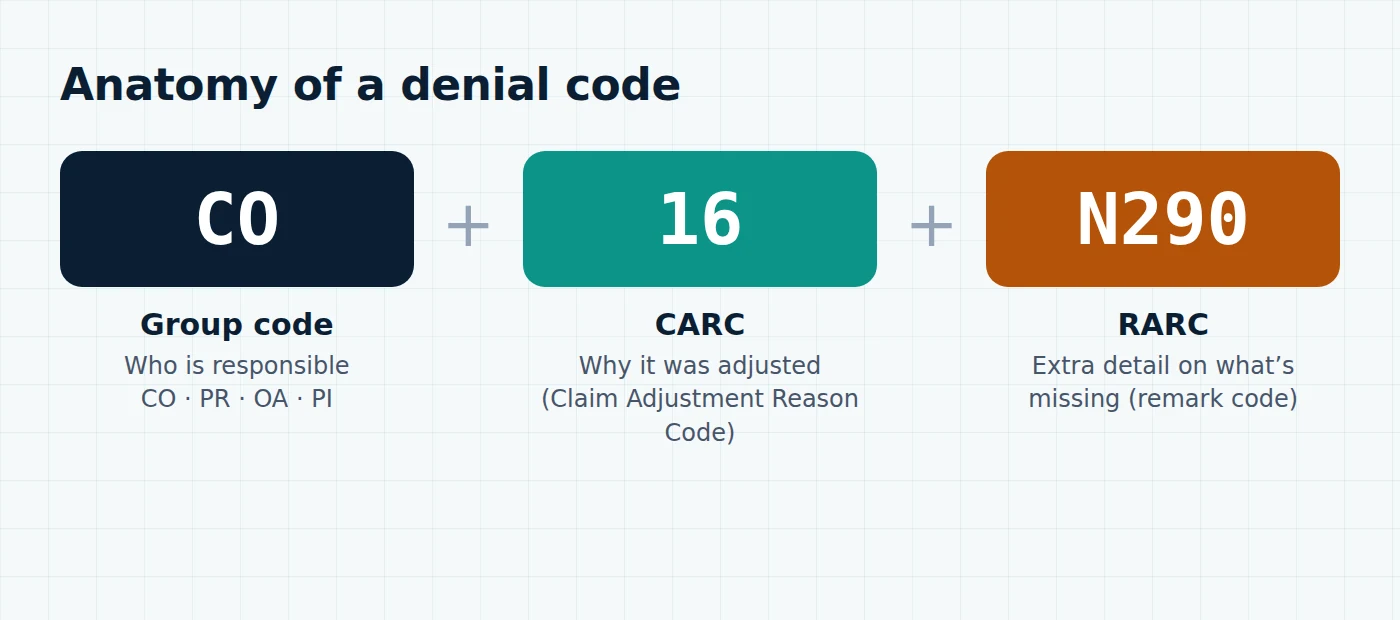
On an ERA (835) or EOB, each adjustment has two parts:
- Group code: who is responsible for the amount.
- CARC (Claim Adjustment Reason Code): why the amount was adjusted. It’s often paired with a RARC (Remittance Advice Remark Code, such as N- or M-codes) that adds detail.
The four group codes
- CO: Contractual Obligation. The provider is responsible; you generally can’t bill the patient. Most true denials are CO.
- PR: Patient Responsibility. The amount can be billed to the patient (deductible, coinsurance, copay, or a non-covered service with a valid waiver).
- OA: Other Adjustment. Neither CO nor PR applies, often used with coordination of benefits.
- PI: Payer Initiated reduction. The payer reduced payment for a reason that isn’t a contractual obligation.
Always read the RARC too. The CARC tells you the category; the remark code usually tells you exactly what’s missing, such as which data element or which policy.
The most common denial codes and how to fix them
Front-end and eligibility denials
- CO-27: coverage terminated before the date of service. Re-verify eligibility for the DOS, look for new coverage (a new plan, Medicaid, or Medicare Advantage), and rebill the correct payer.
- CO-22: another payer may be primary (coordination of benefits). Confirm COB with the patient and payer, bill the primary first, then send the secondary claim with the primary EOB.
- CO-109: not covered by this payer; send to the correct payer. Common with Medicare Advantage and managed Medicaid plans. Check the member card and the payer ID.
- CO-197: prior authorization or precertification missing. Check whether an auth exists but wasn’t on the claim. If it doesn’t exist, ask the payer about retro-authorization before appealing.
Coding and billing-error denials
- CO-16: claim lacks information or has a billing error. The RARC names the missing item (for example, a referring provider NPI or a claim frequency code). Correct it and resubmit as a corrected claim, not a new one.
- CO-4: procedure inconsistent with the modifier, or a required modifier is missing. Check modifier rules such as 25, 59/X{EPSU}, GP, RT/LT, and 26/TC.
- CO-11: diagnosis inconsistent with the procedure. The ICD-10 code doesn’t support the service. Confirm the most specific diagnosis in the note and that each line points to the right diagnosis.
- CO-18: exact duplicate claim or service. Check for a prior submission first. If the service really was repeated, add the right modifier (76, 77, 91, or 59) and document it.
Bundling and medical necessity denials
- CO-97: payment is included in another service already paid. Often an NCCI bundle or a visit inside a global surgical period. If the service was distinct, correct with 59/XS/XU (or 24, 25, 79 for E/M) and supporting documentation. Otherwise it’s a valid denial.
- CO-236: procedure not compatible with another procedure on the same day under NCCI. Check the NCCI pair and its modifier indicator. You can run the claim through our claim scrubber before resubmitting.
- CO-50: not deemed medically necessary. Compare the diagnosis and documentation against the payer’s coverage policy (LCD/NCD for Medicare) and appeal with records if the policy is met.
- CO-151: the information submitted doesn’t support this many services or this frequency. Common with therapy and labs. Check frequency limits and document medical necessity for the extra units.
- CO-96: non-covered charge. Check the RARC and benefits. For Medicare, an ABN with modifier GA may make it billable to the patient.
Timely filing and limits
- CO-29: the time limit for filing has expired. Look for proof of timely filing, such as clearinghouse acceptance reports or a prior rejection, and appeal with it. Without proof, this is usually a write-off.
- CO-119: benefit maximum reached for the period. Confirm the visit or dollar limit. If a secondary payer exists, bill it.
- CO-45: charge exceeds the fee schedule or maximum allowable. This is a normal contractual adjustment, not a denial. Don’t appeal it unless the allowed amount doesn’t match your contract.
Patient responsibility codes
- PR-1: deductible. PR-2: coinsurance. PR-3: copay. Bill the patient, and make sure the front desk collects known amounts at check-in.
A simple denial workflow that works
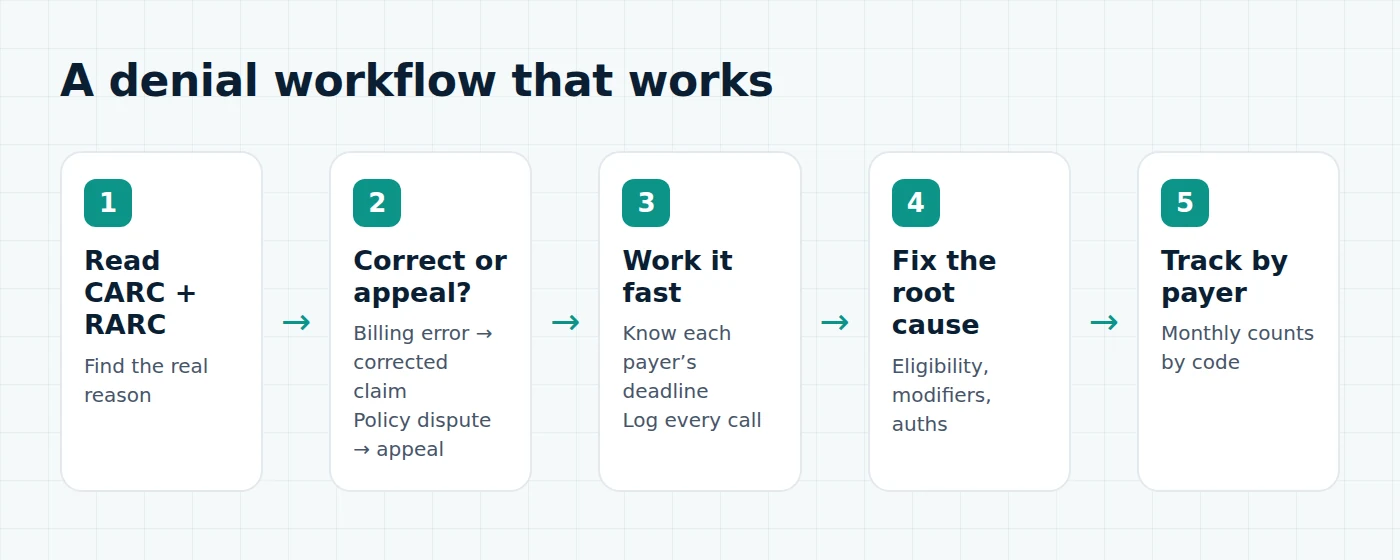
- Read both codes. The CARC plus the RARC tell you the real reason.
- Decide: correct or appeal. Billing errors (CO-16, CO-4, CO-11) usually need a corrected claim. Medical necessity or policy disputes (CO-50, CO-97 with documentation) need an appeal.
- Work it fast. Appeal and corrected-claim deadlines vary by payer; many commercial plans allow 90–180 days. Log every call so the next person has the history; our call note builder keeps notes consistent.
- Fix the root cause. One denied claim is a fix; ten of the same denial is a process problem such as eligibility checks, a missing modifier rule, or a missing auth.
- Track by payer and code. A monthly count of denials by CARC and payer shows exactly where the revenue is leaking.
Frequently asked questions
What’s the difference between a rejection and a denial?
A rejection happens before the claim is accepted (at the clearinghouse or payer front end) because of formatting or data errors. Fix it and resubmit. A denial happens after the payer processes the claim, and needs a corrected claim or an appeal.
Can I bill the patient for a CO denial?
Generally no. CO means the provider is contractually responsible. Only PR amounts, or services where the patient signed a valid waiver (such as an ABN for Medicare), can be billed to the patient.
Where can I find the official code descriptions?
CARC and RARC lists are maintained by X12 and updated several times a year. Your clearinghouse or practice management system usually shows the current description next to each code.
Want the bigger picture? Read how to reduce claim denials by 40%, or get a free denial audit from our team.