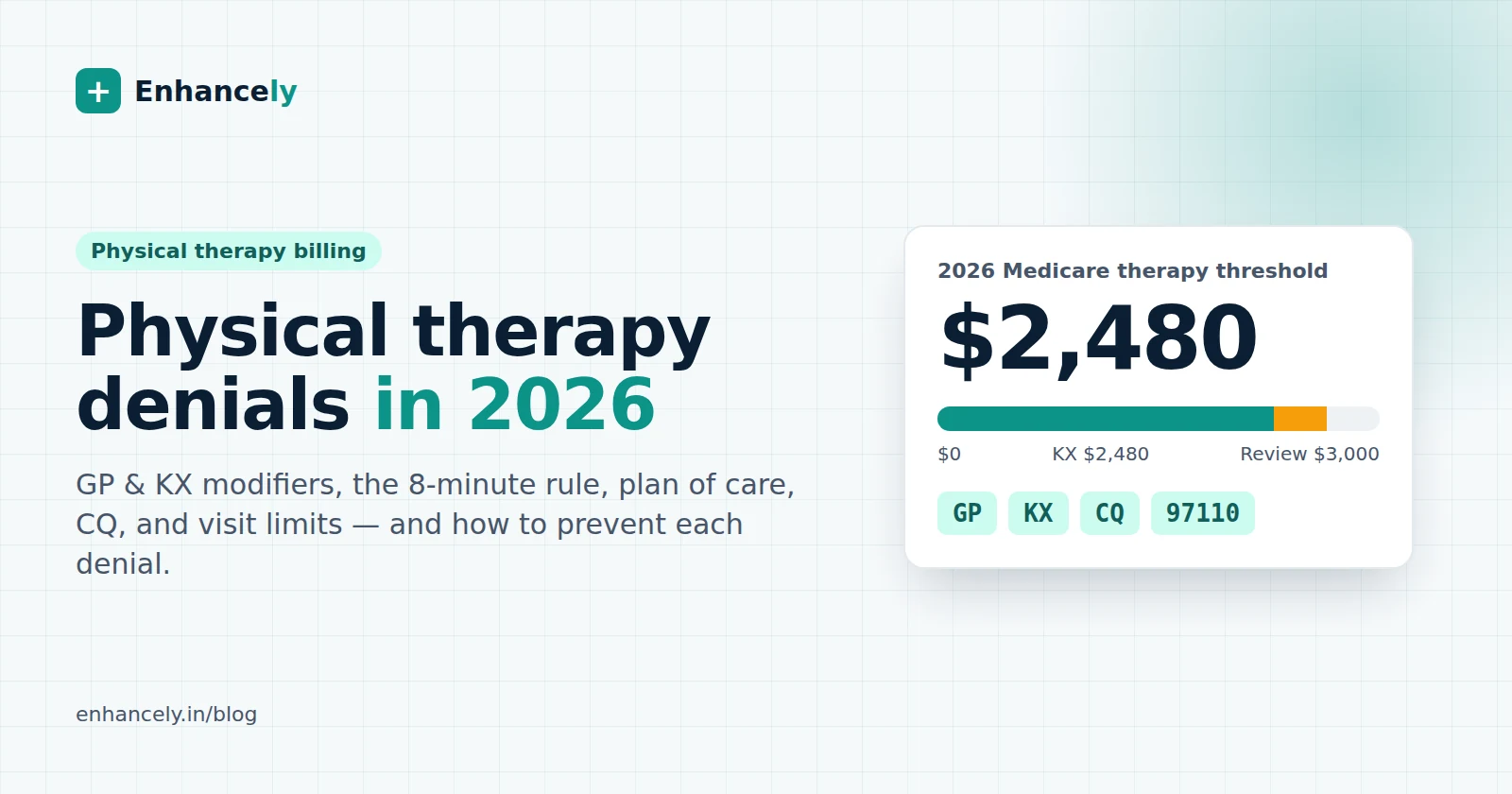
Physical therapy claims get denied for reasons most other specialties never deal with: timed-code units, therapy modifiers, plan of care certification, annual thresholds, and visit limits. The upside is that these rules are predictable. Build them into your intake and billing workflow and most PT denials disappear. Here’s what to watch for in 2026.
1. Missing therapy modifier (GP, GO, GN)
Typical denial: CO-4 (modifier missing or inconsistent).
Medicare and many other payers require a therapy discipline modifier on every therapy service: GP for physical therapy, GO for occupational therapy, and GN for speech-language pathology. This applies to “always therapy” codes such as 97110 and to “sometimes therapy” codes when furnished under a therapy plan of care.
Fix: set GP as a default on PT charge lines in your PM system, and check it’s present before submission.
2. Units that don’t follow the 8-minute rule
Typical denials: CO-151 (units or frequency not supported) or payment reductions on audit.
For Medicare, timed codes (for example 97110, 97112, 97140, 97530) are billed in 15-minute units based on the total timed minutes of the visit, not each code separately. A unit needs at least 8 minutes.
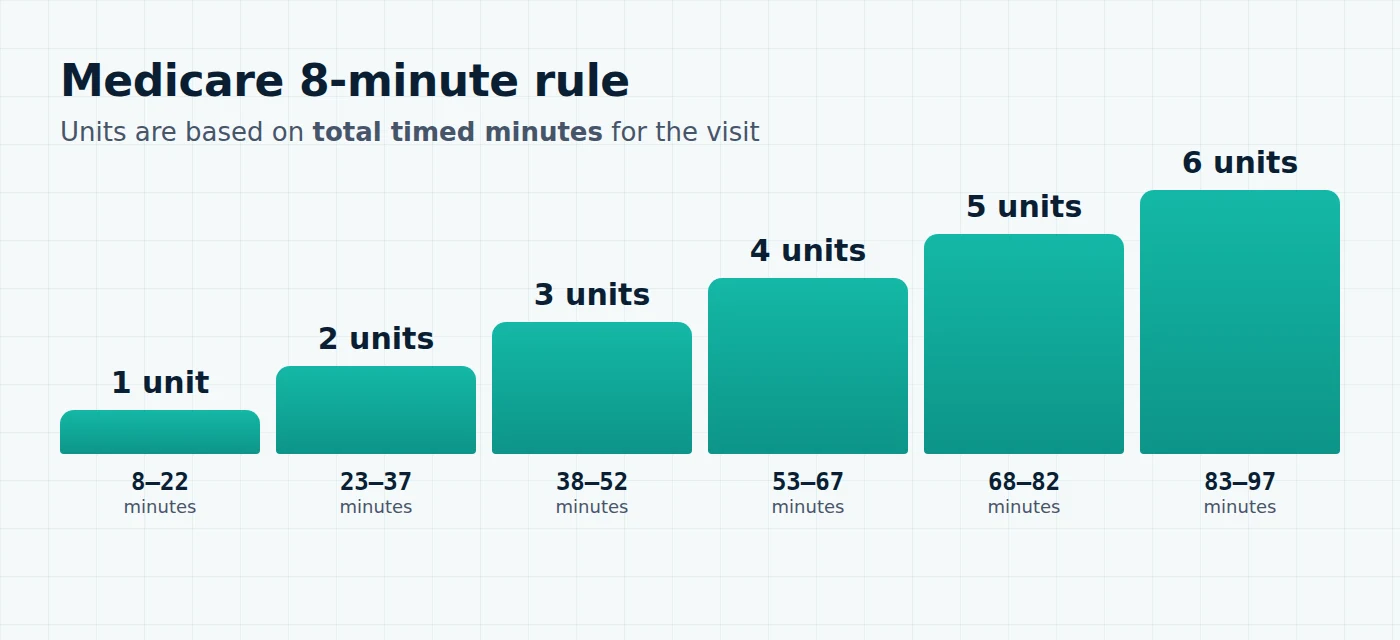
- 8–22 minutes = 1 unit · 23–37 = 2 units · 38–52 = 3 units · 53–67 = 4 units · 68–82 = 5 units
- Assign units to the codes with the most minutes first, and never bill more units than the total supports.
- Untimed codes (such as evaluations 97161–97163 and re-evaluation 97164) are billed as 1 unit regardless of time.
- Some commercial payers use the “substantial portion” method instead (8+ minutes per code). Check each payer’s policy.
Fix: document start/stop or total minutes for each timed code, plus total timed minutes for the visit.
3. Plan of care not certified
Typical denials: CO-16 or CO-50 on medical review.
Medicare requires the therapy plan of care to be certified by the patient’s physician or NPP, and recertified when the plan changes significantly or when the certified period ends (at least every 90 days). Missing or late certifications are a common reason for therapy takebacks on audit.
Since 2025, CMS allows an exception for the initial certification: if a written order or referral from the physician/NPP is on file and the therapist documents that the plan was sent to that physician/NPP within 30 days of the initial evaluation, a signature on the plan isn’t required for the initial certification.
Fix: track certification and recertification dates for every patient, and keep proof of when the plan was sent.
4. KX modifier and the 2026 therapy threshold
Medicare no longer has a hard therapy cap, but it has a KX modifier threshold. For 2026 it’s $2,480 for PT and SLP combined, and $2,480 for OT.
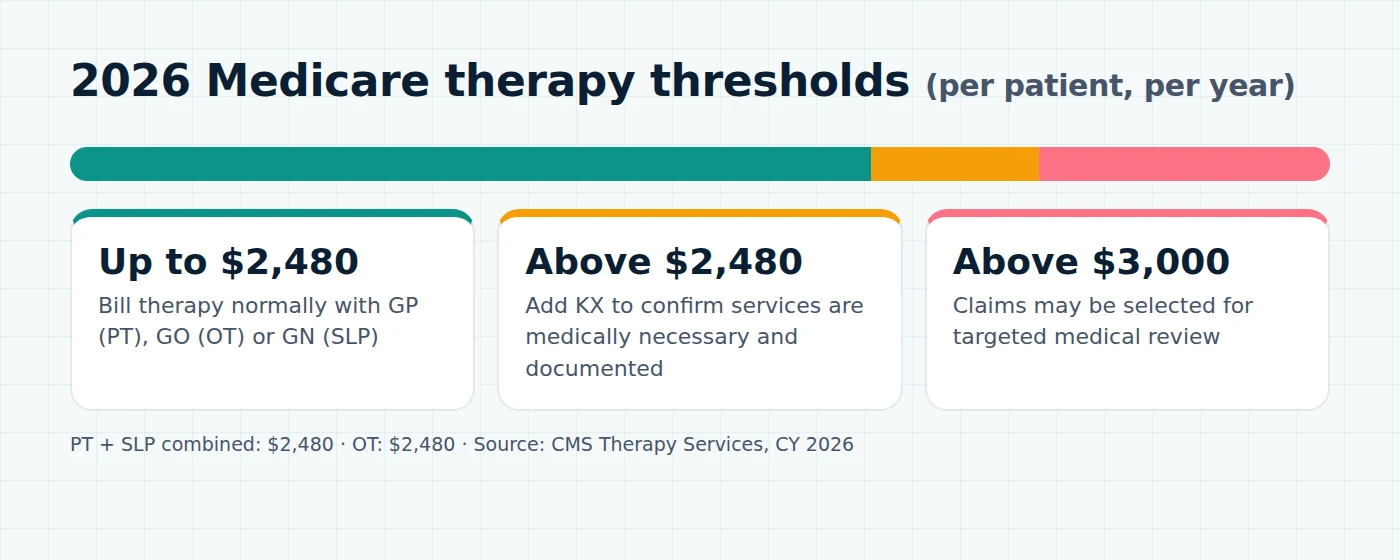
- Once a patient’s allowed therapy charges for the year pass the threshold, add KX to confirm the services are medically necessary and documented. Without KX, claims above the threshold are denied.
- Above $3,000, claims may be selected for targeted medical review.
- The threshold counts all providers’ therapy for that patient in the year, not just yours. Check the patient’s year-to-date amount in the eligibility response.
5. Therapy assistant services without CQ or CO
When a PTA furnishes all or part of a service (more than 10% of it), Medicare requires modifier CQ (CO for an OTA), and pays those services at 85% of the fee schedule. A missing CQ can lead to overpayment findings on audit. Since 2025, PTs in private practice may supervise PTAs under general supervision.
6. NCCI edits between therapy codes
Typical denials: CO-97 or CO-236.
Some common therapy pairs are bundled under NCCI when performed in the same session, for example manual therapy (97140) billed with certain other procedures, or evaluation codes with some treatment codes. If the services were distinct (different body regions or separate time intervals, and documented that way), modifier 59 or an X modifier may apply. Our free claim scrubber flags modifier conflicts before you submit.
7. Authorization and visit limits (commercial and Medicare Advantage)
Typical denials: CO-197 (no authorization) and CO-119 (benefit maximum reached).
- Many commercial and Medicare Advantage plans require prior authorization after the evaluation, or after a set number of visits.
- Annual visit limits often combine PT, OT, and chiropractic.
Fix: verify visit limits and auth rules at intake, track visits used against authorized visits, and request more visits before the current auth runs out.
8. Medical necessity and progress documentation
Typical denial: CO-50.
Notes need to show skilled therapy that only a therapist can provide, measurable goals, and progress toward them. Medicare expects a progress report at least once every 10 treatment days. Maintenance-only care must still show why the skills of a therapist are required.
PT denial prevention checklist
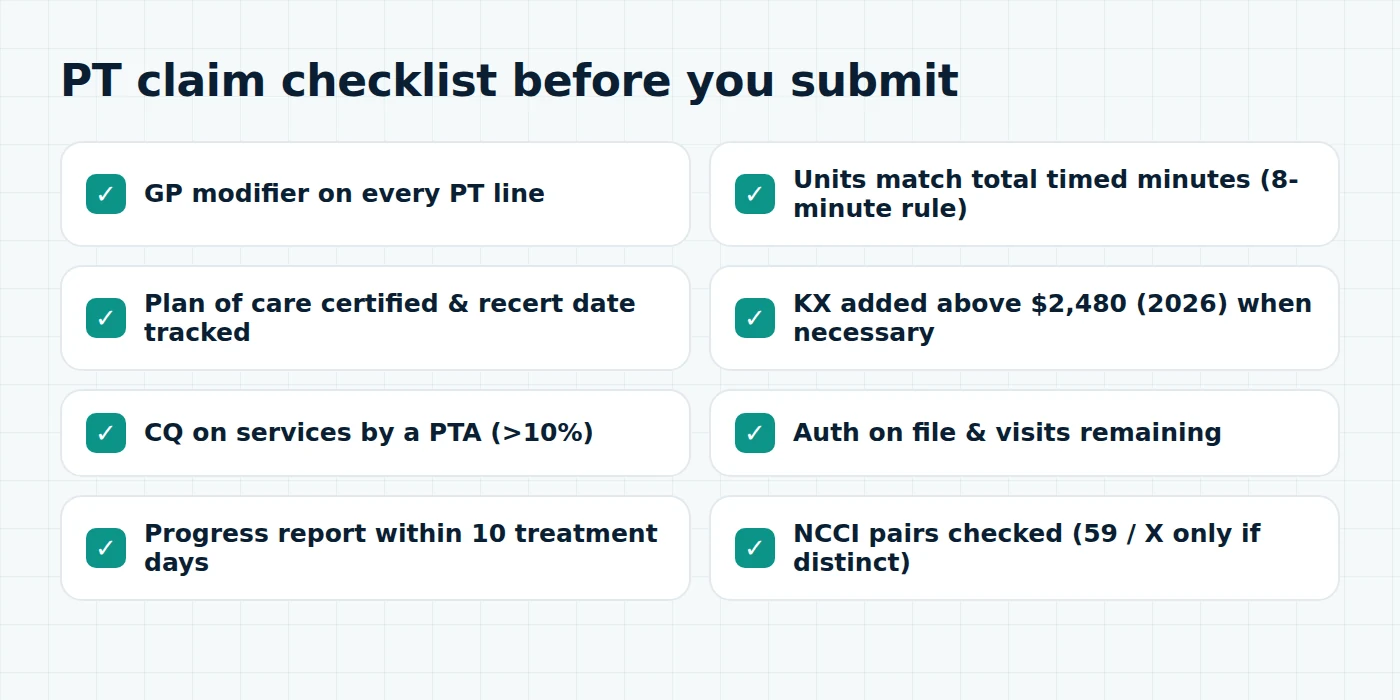
- Verify benefits, visit limits, auth rules, and year-to-date therapy amounts at intake.
- Put GP on every PT line.
- Count units with the 8-minute rule (or the payer’s method) from documented timed minutes.
- Track plan of care certification and recertification dates.
- Add KX above $2,480 (2026) when medically necessary, with documentation to match.
- Add CQ when a PTA furnishes more than 10% of a service.
- Write progress reports at least every 10 treatment days.
- Scrub for NCCI conflicts and modifier errors before submitting.
Want a second set of eyes on your therapy claims? Request a free 48-hour audit.