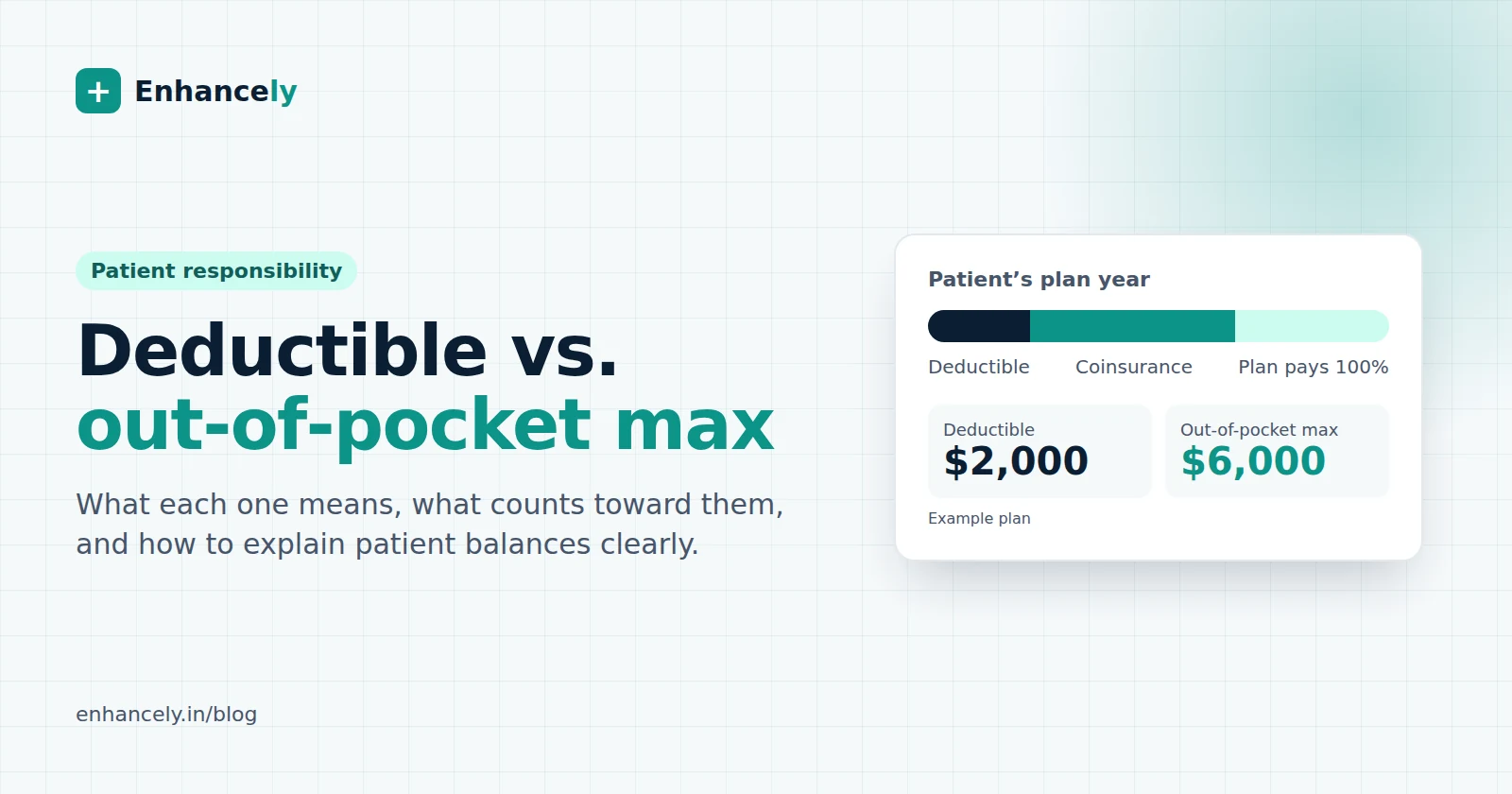
“I already paid my deductible, so why do I still owe money?” It’s one of the most common questions patients ask a billing office, and it comes from mixing up two different numbers on a health plan: the deductible and the out-of-pocket maximum. This guide explains both in plain language, walks through a worked example, and covers what billing teams should check before collecting patient balances.
The short answer
- The deductible is what the patient pays for covered services before the plan starts sharing costs.
- The out-of-pocket maximum (also called the out-of-pocket limit) is the most the patient will pay for covered, in-network services in a plan year. After it’s reached, the plan pays 100% of covered services for the rest of that year.
- The deductible counts toward the out-of-pocket maximum. It’s the first part of it, not a separate bucket.
What is a deductible?
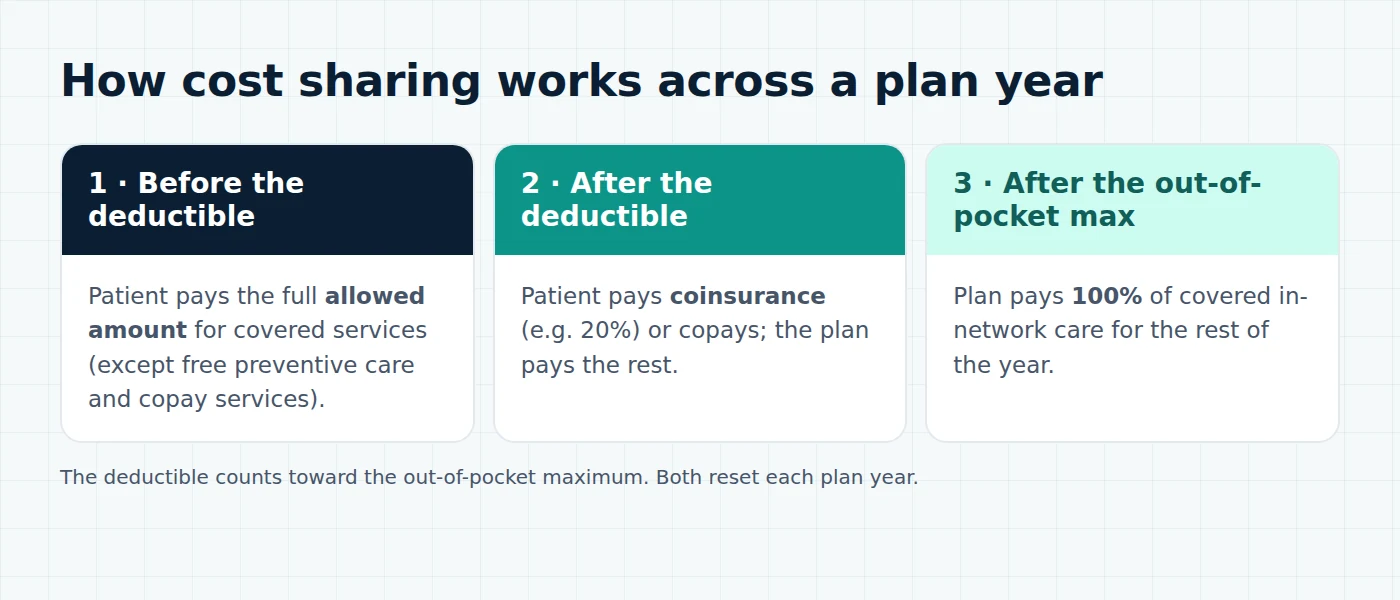
A deductible is the amount the patient pays for covered health care services before the insurance plan starts to pay its share. If a plan has a $2,000 deductible, the patient generally pays the full allowed amount (the plan’s contracted rate, not the provider’s full charge) for covered services until they’ve paid $2,000 in that plan year.
- Not everything waits for the deductible. Many plans cover in-network preventive care at no cost, and some services (like office visits on many plans) use a flat copay even before the deductible is met.
- It resets at the start of each plan year, often January 1, but not always. Employer plans may run on a different plan year.
- Family plans may have an embedded deductible (each person has their own, plus a family total) or a non-embedded deductible (the whole family total must be met before the plan pays for anyone). This matters a lot when estimating a patient’s balance.
What is an out-of-pocket maximum?
The out-of-pocket maximum is the cap on what the patient pays for covered, in-network services during the plan year. Once the patient’s deductible, coinsurance, and copays add up to that amount, the plan pays 100% of covered in-network services until the plan year ends.
For most ACA-compliant plans, federal rules set an upper limit on how high the out-of-pocket maximum can be, and that limit is updated every year. Check HealthCare.gov for the current year’s figures. Individual plans can, and often do, set a lower maximum.
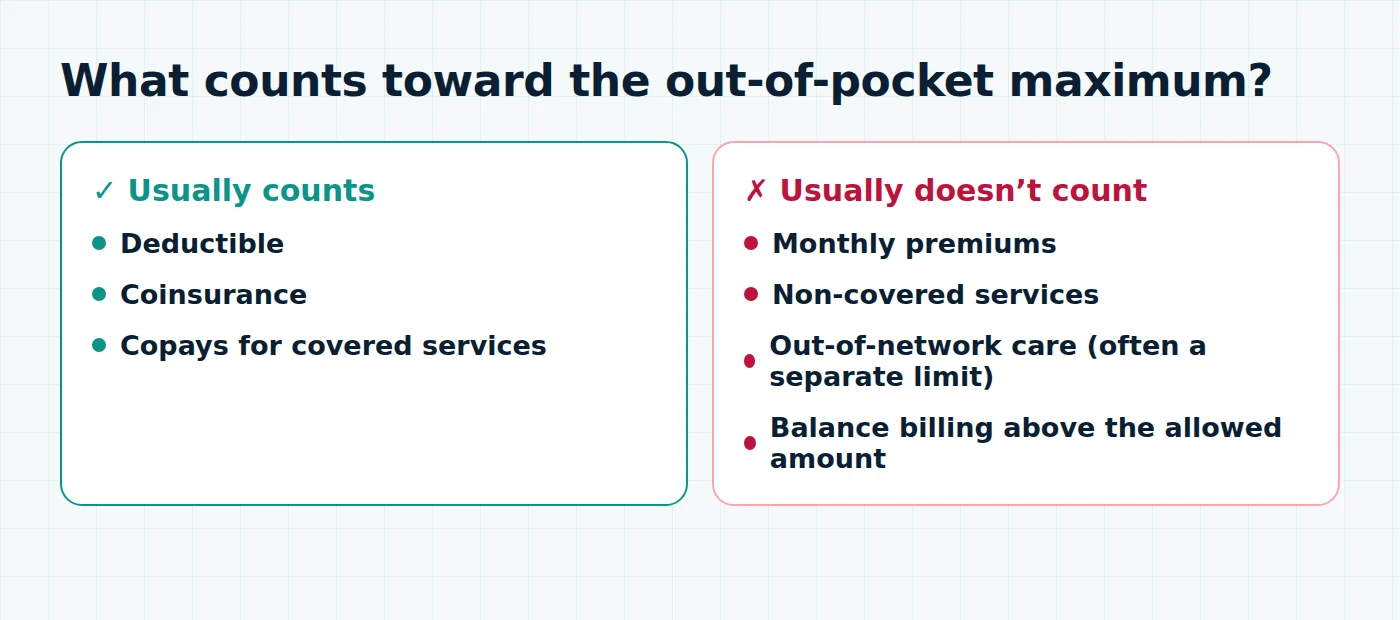
What counts toward the out-of-pocket maximum
- The deductible
- Coinsurance (for example, the patient’s 20%)
- Copays for covered services
What usually doesn’t count
- Monthly premiums
- Services the plan doesn’t cover
- Out-of-network care (on many plans, or toward a separate, higher out-of-network maximum)
- Balance billing from out-of-network providers: the difference between the provider’s charge and the allowed amount
Deductible vs. out-of-pocket maximum: side by side
- What it is: The deductible is the amount paid before the plan shares costs. The out-of-pocket maximum is the most paid in a year.
- Which is higher: The out-of-pocket maximum is always equal to or higher than the deductible, because it includes it.
- What happens after it’s met: After the deductible, the patient usually pays coinsurance. After the out-of-pocket maximum, the patient pays nothing more for covered in-network care that year.
- Reset: Both reset at the start of the plan year.
A worked example
Here’s how one plan would handle a year of care. The numbers below are for illustration only, not a specific plan or a federal limit.
- Deductible: $2,000
- Coinsurance after the deductible: 20%
- Out-of-pocket maximum: $6,000
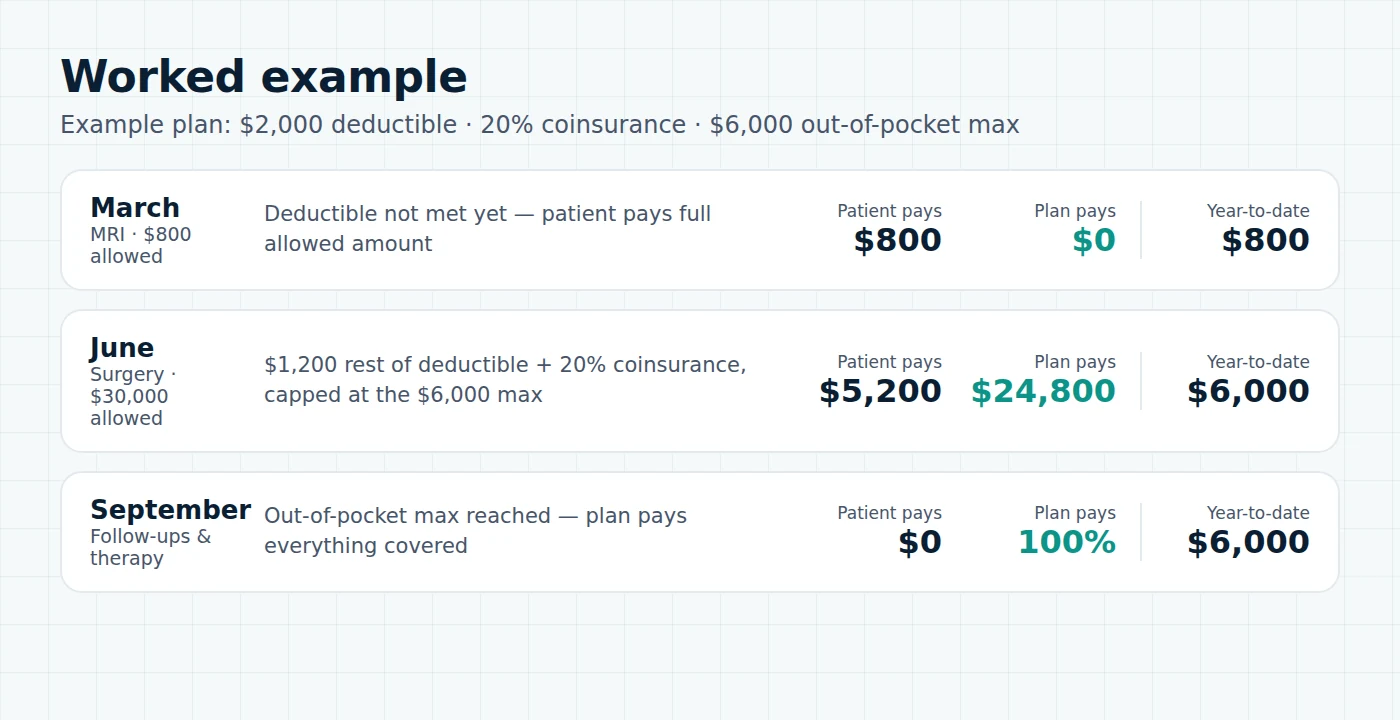
- March: an MRI with an $800 allowed amount. The deductible isn’t met yet, so the patient pays the full $800. They now have $1,200 left on the deductible.
- June: surgery with a $30,000 allowed amount. The patient pays the remaining $1,200 of the deductible, then 20% of the remaining $28,800, which would be $5,760. But that would bring their total for the year to $7,760, over the $6,000 cap. So they pay only $5,200 for the surgery, reaching the $6,000 maximum. The plan pays the rest: $24,800.
- September: follow-up visits and physical therapy. The out-of-pocket maximum is met, so the plan pays 100% of covered in-network services. The patient owes $0 for the rest of the plan year.
Key takeaway: meeting the deductible doesn’t mean the patient stops paying. It means they start sharing costs. Meeting the out-of-pocket maximum is what stops their costs for the year.
What this means for billing teams
Getting patient responsibility right protects collections and patient trust. Before collecting or sending a statement:
- Check the accumulators on eligibility. The eligibility response (271) or payer portal shows how much of the deductible and out-of-pocket maximum has been met, for the individual and the family. Note the date, because those numbers change as other providers’ claims process.
- Read the patient responsibility codes on the ERA. PR-1 is deductible, PR-2 is coinsurance, and PR-3 is copay. Bill the patient only the PR amounts, not CO adjustments. Our guide to claim denial and adjustment codes explains each one.
- Watch for claims processed out of order. If another provider’s claim processes first, it may use up the patient’s deductible, and your claim could come back with more of it paid by the plan than you estimated, or the other way around. Collect estimates conservatively and reconcile when the ERA arrives.
- Refund promptly when the max is hit. If a patient paid at the time of service and the ERA shows they had already reached their out-of-pocket maximum, the overpayment needs to be refunded or applied according to your policy and payer rules.
- Explain it in plain words. A short phrase at checkout, such as “you’ve met your deductible, so your plan now pays 80% and you pay 20% until you reach your $6,000 limit,” prevents most billing disputes.
Special cases
High-deductible health plans (HDHPs) with an HSA
HSA-eligible plans have IRS-set minimum deductibles and maximum out-of-pocket limits that change each year. On many HDHPs, even office visits and prescriptions count toward the deductible before any copays apply, so patients often owe the full allowed amount early in the year.
Medicare
Original Medicare (Parts A and B) has deductibles and coinsurance, but no annual out-of-pocket maximum. That’s one reason many beneficiaries buy a Medigap supplement. Medicare Advantage plans do have an annual out-of-pocket limit for in-network covered services, set by each plan up to a CMS maximum.
Separate in-network and out-of-network limits
PPO plans often have one deductible and out-of-pocket maximum for in-network care and a separate, higher set for out-of-network care. Amounts usually don’t cross over between the two.
Changing plans mid-year
A new plan usually means a new deductible and out-of-pocket maximum, and amounts already paid on the old plan generally don’t carry over. Patients can usually only switch plans outside open enrollment if they have a qualifying life event, such as losing other coverage, moving, marriage, or having a baby. This guide to special enrollment periods and qualifying life events explains who qualifies and the deadlines to enroll. Billing teams should re-verify eligibility whenever a patient mentions a plan change.
Frequently asked questions
Is the out-of-pocket maximum the same as the deductible?
No. The deductible is the first part of what a patient pays. The out-of-pocket maximum is the total cap, including the deductible, coinsurance, and copays.
Do copays count toward the deductible?
Usually not. Copays generally count toward the out-of-pocket maximum but not toward the deductible. Check the specific plan, because some do.
Does the out-of-pocket maximum include premiums?
No. Premiums are what you pay to have coverage and never count toward the deductible or the out-of-pocket maximum.
What happens after the out-of-pocket maximum is met?
The plan pays 100% of covered, in-network services for the rest of the plan year. Non-covered services, out-of-network care, and premiums still apply.
This article explains general health plan concepts. Plan designs vary, so always check the patient’s Summary of Benefits and Coverage and the payer’s eligibility response for exact amounts.
Need help getting patient balances right? Request a free 48-hour revenue audit from our billing team.